Your Competitors Aren't Better Than You - They Just Have This One System
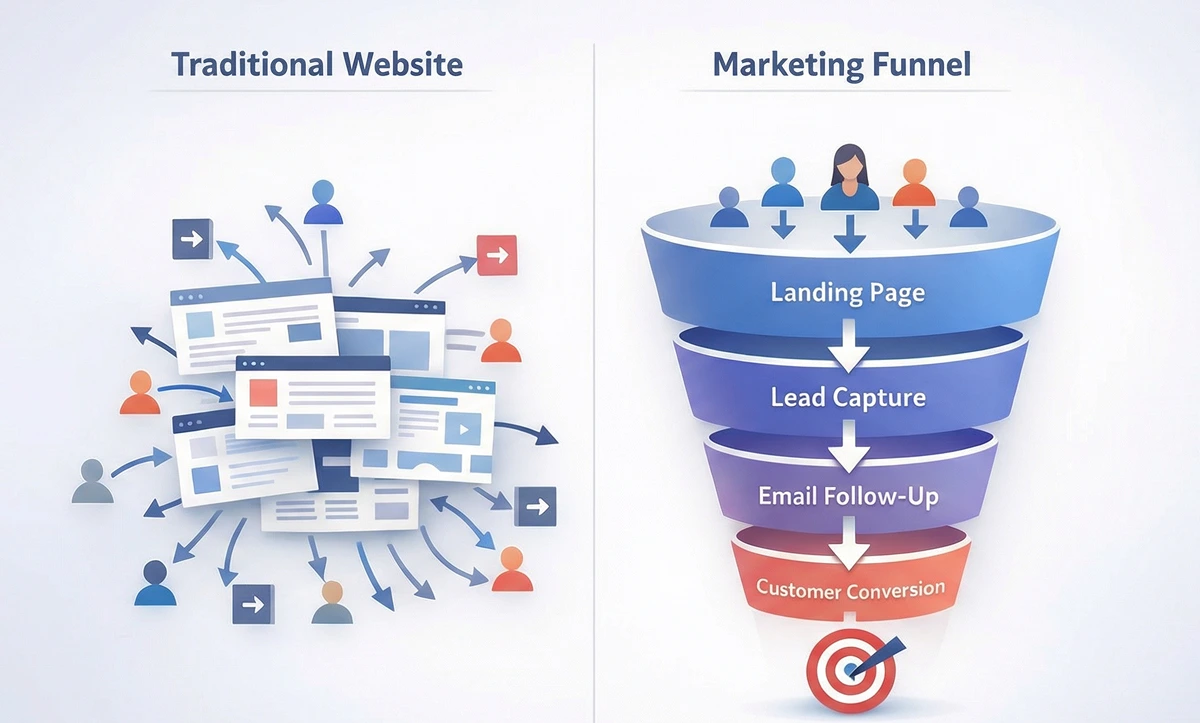
You spent thousands building a beautiful website.
Professional design. Clear messaging. A contact form at the bottom.
And then... nothing.
A few visits here and there. The occasional inquiry from someone who already knew you. But the steady stream of inbound leads you were expecting? It never came.
Here's the uncomfortable truth most web designers won't tell you: a website, on its own, was never designed to generate leads. It was designed to look credible. There's a significant difference between the two.
The Digital Brochure Problem
Think about what a traditional brochure does. You hand it to someone, they glance at it, maybe flip through it, and then they set it down and move on with their day.
Most websites work exactly the same way.
A visitor lands on your homepage, reads a paragraph or two, skims your services page, and leaves. No inquiry. No trace. Just a bounce rate statistic that makes you quietly uncomfortable every time you log into Google Analytics.
The problem isn't your copywriting. It's not your design. It's that your website is structured as a destination, not a system.
Destinations are passive. Systems are active.
Successful businesses don't just build destinations. They build systems that take a visitor by the hand and guide them somewhere specific.
That system has a name: a funnel.
What a Funnel Actually Is (Without the Marketing Jargon)
Forget everything you've heard about funnels from people trying to sell you a course.
At its core, a funnel is simply a guided path. It takes someone from "I just found you" to "I want to work with you" — one step at a time, with as little friction as possible.
A website says: here's everything we do, look around.
A funnel says: here's one specific problem we solve — want us to help you with it?
The difference in conversion rate between those two experiences is not small. It's often the difference between zero leads per month and a calendar full of booked calls.
Why Websites Alone Fail to Convert
Let's be specific about where the cracks are.
Too many options. Most websites have navigation menus with six or seven pages, multiple service offerings, a blog, an about page, and a contact form. When you give visitors too many choices, they make no choice at all. Funnels remove the noise and focus on a single, clear next step.
No lead capture. If someone visits your website and isn't ready to hire you today — which describes the vast majority of your traffic — they leave with nothing. You lose them forever. A funnel captures their contact information before they go, so you can continue the conversation.
No follow-up system. Even when someone does reach out, most businesses follow up once or twice and then let the conversation die. The data consistently shows that most sales happen between the fifth and twelfth touchpoint. Without an automated follow-up sequence, you're leaving deals on the table every single week.
Visitors leave without a trace. Your website might be getting decent traffic. But if you're not capturing emails or running retargeting, those visitors disappear permanently. A funnel changes the economics of your traffic entirely.
What a Simple Funnel Looks Like for a Service Business
Here's the basic architecture, stripped down to what actually matters:
- Traffic arrives — from an ad, a Google search, a LinkedIn post, or a referral.
- They land on a focused landing page — not your homepage, but a page built around one specific offer or problem.
- A lead magnet or low-barrier offer is presented — a free guide, a checklist, a short audit, a strategy session — something valuable enough to exchange an email address for.
- Email is captured — and immediately, automation takes over.
- A sequence of emails follows — educational, trust-building, and gradually moving the prospect toward a decision. These go out automatically, whether you're working or sleeping.
- A clear call to action closes the loop — book a call, start a trial, request a proposal.
That's it. No magic. No complexity. Just a logical progression that works while you're doing everything else running a business requires.
The Tools That Make This Work
You don't need to build anything exotic. The technology has matured significantly in the past few years.
For all-in-one funnel and CRM systems: GoHighLevel is increasingly popular with agencies and service businesses. It handles landing pages, email sequences, SMS follow-ups, and appointment booking under one roof. ClickFunnels built the category and still works well for simpler setups.
For website-based funnels: If you prefer to stay on your existing platform, WordPress combined with a tool like Elementor or a dedicated plugin can handle most funnel structures. Webflow offers more design flexibility for businesses that care about brand presentation.
For email and automation: ActiveCampaign, ConvertKit, and Mailchimp all handle automated sequences well. The tool matters less than the strategy behind it.
For CRM and follow-up: HubSpot's free tier covers a lot of ground for smaller teams. Pipedrive is cleaner for pure sales pipelines. GoHighLevel, again, rolls this in if you want fewer logins.
The point isn't the tool. The point is that these systems exist, they're affordable, and there's no good reason not to have one.
What This Looks Like in Practice
A business consultant runs a LinkedIn ad targeting founders at early-stage companies. The ad links to a landing page offering a free "90-Day Growth Audit" — not a sales pitch, just something genuinely useful. The visitor enters their email, receives the audit template, and gets enrolled in a five-email sequence over two weeks. Email three invites them to book a 30-minute call. Roughly 20–30% of people who download the audit end up booking that call.
A marketing agency writes a blog post about the biggest mistakes companies make with Google Ads. Halfway through the article, there's an offer for a free account review. Visitors opt in, the agency's team gets a notification, and an automated email confirms the request while the prospect is still warm. Within 48 hours, a qualified conversation is already underway.
A SaaS product offers a free trial with an onboarding email sequence that teaches new users how to get value quickly — not to show off features, but to drive that first "aha moment" before the trial expires. Each email is triggered by behavior inside the product. The result: trial-to-paid conversion doubles.
Different businesses, different offers, same underlying logic.
The Real Benefit: Predictability
Here's what nobody talks about enough.
The reason funnels matter isn't just lead generation. It's the shift from unpredictable to predictable.
When your marketing is just a website and hope, your pipeline looks like a random heartbeat — some months good, some months desperate. When you have a funnel, you know approximately how many visitors become leads, how many leads become calls, and how many calls become clients. You can measure it. You can improve it. You can scale it.
That's a fundamentally different business to operate.
Automated follow-up means no lead gets forgotten. Measurable performance means you know where to invest next. A clear path means your prospects aren't confused about what to do.
The Mindset Shift That Changes Everything
Stop thinking about your website as your marketing strategy.
Your website is a piece of real estate on the internet. A funnel is what happens on that real estate. The most beautiful building in the world generates no revenue if there's no system inside it to convert visitors into customers.
The businesses that consistently win — the consultants who are always booked, the agencies with six-month waitlists, the SaaS products growing without a massive sales team — they didn't just build a website and wait.
They built a system. A system that captures interest automatically, nurtures it intelligently, and converts it predictably.
Your website is live. That's table stakes.
Now it's time to build the system behind it.
I design and build marketing funnels for service businesses and founders who are tired of watching their website traffic go nowhere. If that's you, let's talk.
Ceyonra Team
Helping businesses scale with software.